

Kanna – the Plant That Teaches the Heart to Remember Inner Peace
Sceletium tortuosum
Africa is the cradle of human culture, ancient stories, and a rich body of knowledge about the healing power of plants. The vast continent can be regarded as the foundation of all other human cultures. It harbours more wisdom than any other continent.
One of these remarkable plants is kanna (Sceletium tortuosum), which has been used for many thousands of years by the San and the Khoikhoi, the indigenous peoples of Southern Africa. The ancestors of these peoples belong to the oldest surviving human populations in the world and are regarded as important custodians of deeply rooted knowledge about humanity, nature, and consciousness. The plant has also been known in Europe since the seventeenth century, when traders attempted to sell its roots—known to them as ningin—in Japan as a kind of African ginseng.
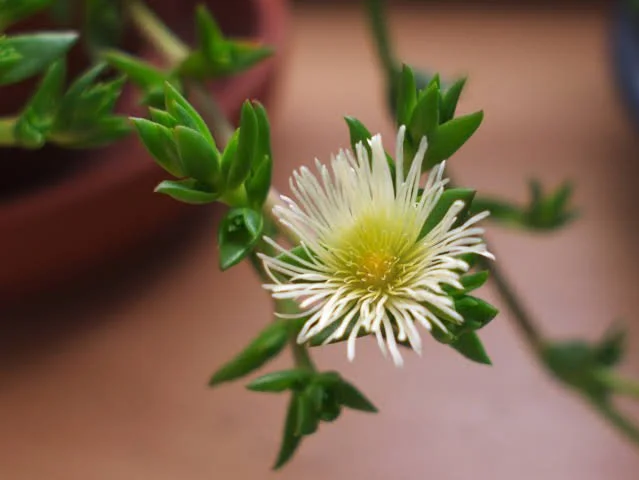
Kanna grows naturally in the arid and semi-arid landscapes of South Africa, particularly in the Karoo and Namaqualand. It thrives on rocky slopes and sandy soils, where its fleshy leaves enable it to withstand long periods of drought. The traditionally fermented kanna that I came to know was gathered and prepared among the rugged rocks of the Baviaanskloof. Kanna is a succulent that is easily overlooked. Its thick, pale green leaves store water, allowing the plant to survive prolonged dry spells. In English, kanna is also known as the ice plant, a name referring to the glistening leaf cells that resemble tiny ice crystals in the sunlight. In spring, the plant produces small flowers that may be white, yellow, or pale pink. Traditionally, the Khoisan harvested kanna in spring, usually during October and November. This plant, Sceletium tortuosum, better known as kanna or kougoed, is once again coming to us as a gift from the indigenous peoples of Southern Africa. By sharing their ancient knowledge with the world, they contribute not only to our health but also to reconciliation and mutual understanding after a long history of colonial oppression. During the 1990s the plant became widely known through smart shops, and today even a standardised and patented extract is available.
Traditionally, kanna was used by various Khoi and San communities, whom anthropologists often collectively refer to as the Khoisan peoples. The San and the Khoikhoi speak related languages distinguished by their characteristic click consonants and share a common genetic and cultural origin. Although they are often associated with the Kalahari, their traditional territory extended far beyond this famous semi-desert. The principal traditional distinction between them lies in their way of life: the San originally lived as hunter-gatherers, whereas the Khoikhoi were primarily pastoralists.
Kanna has been used traditionally for a very long time by both the San and the Khoikhoi. Both peoples chewed and snuffed the fermented plant for its relaxing, mood-enhancing, and socially connecting properties. The plant was also given to children to help them sleep better and to relieve constipation. Even pregnant women used it to combat nausea and promote digestion. During the colonial period, the indigenous inhabitants were referred to by European colonists as "Hottentots," probably in reference to the characteristic click sounds of their language. In their accounts, the first Europeans already described the use of kanna among the Hottentots. Today, this designation is regarded as offensive. Their own name, Khoikhoi, means "the real people" or "the true people." Together with the San, they belong to one of the oldest surviving human cultures on Earth. The Khoisan also possess an ancient entheogen that has probably been in use far longer than ayahuasca or peyote, although this cannot be established with scientific certainty. Kanna is truly a primordial entheogen.
For the indigenous peoples of Southern Africa, sometimes also referred to as Bushmen or as the Khoi and San peoples, kanna was far more than simply a plant. They lived for thousands of generations in close harmony with nature and discovered that certain plants nourish not only the body but also soothe the mind. Kanna was used during long hunting expeditions, rituals, gatherings, and moments when peace was more important than being right. The plant helped people to listen to themselves before speaking to another. After all, peaceful communication always begins within.
Although the traditional cultural region in which kanna is used is relatively small, the wisdom associated with it extends far beyond its geographical origin. Today, kanna is once again finding its way into the world, where increasing numbers of people are seeking natural support for stress, trauma, and the restoration of genuine connection—with themselves, with others, and with nature.
Traditionally, kanna was not simply picked and eaten. To balance its effects, it was fermented. The above-ground parts, sometimes together with the underground parts of the plant, were harvested, crushed, and then fermented for several days to a week in sealed animal skins, leather bags, or beneath stones. Afterwards, the material was dried in the sun. Through this traditional extraction and fermentation process, the composition of the plant changed, undesirable substances such as oxalic acid were reduced, and the characteristic active alkaloids became more readily available. The kanna was then chewed, drunk as a tea, or finely ground for ceremonial use. The plant was also taken as snuff. If you use the fresh plant, nothing happens. Fermentation is essential.
What makes kanna so remarkable is that it does not numb; rather, it can create space. Its principal alkaloids, including mesembrine, mesembrenone, and mesembrenol, act, among other things, as a Serotonin Reuptake Inhibitor (SRI). This means that the reuptake of serotonin in the brain is inhibited, allowing this important neurotransmitter to remain available between nerve cells for a longer period of time. Serotonin plays an important role in mood, emotional balance, resilience, and the experience of connectedness. In addition, certain kanna alkaloids also influence the enzyme PDE4, which is involved in processes related to stress, memory, and inflammation. Together, these mechanisms explain why people often describe kanna as relaxing, mood-enhancing, and socially connecting. Kanna may be described as a natural anxiolytic: a plant that reduces anxiety, promotes inner calm, and supports emotional well-being. In addition, kanna is used to support people with mild depressive symptoms, and research is investigating whether the plant may help break patterns of addiction and other psychological disorders. The pharmacological properties of kanna are promising and therefore deserve further scientific investigation.
Although kanna possesses mild psychotropic properties, these are very different from those of hallucinogenic and vision-inducing plants. Everyday reality does not disappear or change; for many people, it is the mist that seems to disappear instead. Thoughts become gentler, emotions less sharp, and the heart once again has room to feel without becoming overwhelmed.
Perhaps this is precisely where its significance for Western culture lies. We live in a world in which stress, loneliness, burnout, and unresolved trauma are becoming increasingly common. We possess unprecedented technology, yet sometimes find it difficult to be truly present with ourselves or with one another. Kanna reminds us that healing does not always begin by working harder, but sometimes by becoming gentler.
That does not mean that kanna is a miracle cure or that it can simply erase trauma. It does, however, help and support us in processing trauma. Scientific interest in the plant is growing precisely because it may provide support for stress regulation, anxiety, and emotional well-being, alongside other forms of guidance and therapy. Perhaps that is its greatest gift: not the removal of the past, but the opening of a door through which recovery becomes possible.
Perhaps, then, the true power of kanna lies not only in its chemistry, but also in its message. A small succulent from the dry south of Africa teaches us that peace begins within our own hearts. When we learn once again to listen—to our feelings, our breath, and one another—space is created for compassion. And perhaps that is precisely the plant power that the world longs for most today.
When we experience a traumatic event, we often unconsciously respond later from that old trauma. Our reactions are then no longer determined by the present moment, but by experiences from the past. The aim of trauma therapy is precisely to recognise these automatic patterns, process them, and increasingly respond from a place of inner peace rather than fear.
A growing body of scientific research also shows that the consequences of trauma can sometimes extend across multiple generations. Certain traumatic experiences may leave traces that can possibly be passed on to children and even grandchildren. In addition, beliefs, fears, and behavioural patterns are often transmitted culturally. As a result, families, communities, and even entire societies may continue to repeat behaviours whose original purpose has long since been forgotten.
A good illustration of this is a well-known management parable about a group of monkeys. Although this story does not describe an actual scientific experiment, it vividly illustrates how behaviour can become deeply embedded within a group.
In the story, a bunch of bananas is placed on top of a cabinet. Every time a monkey attempts to reach the bananas, all of the monkeys are sprayed with ice-cold water. Before long, the group learns that it is safer to leave the bananas alone. Subsequently, one new monkey after another is introduced into the group. Whenever a newcomer reaches for the bananas, it is immediately restrained by the other monkeys. Eventually, every one of the original monkeys has been replaced. Yet not a single monkey attempts to take the bananas anymore. No one knows why it is forbidden; it has simply become the unwritten rule.
The same often happens with people. We inherit beliefs, fears, and habits from our parents, family, culture, or religion without any longer knowing where they originally came from. Someone may, for example, be afraid of dogs because one of their parents was once bitten, even though they themselves have never had a bad experience. Or someone may believe that emotions should always be suppressed simply because that has been the family norm for generations. Some of these patterns still protect us, while others arose under circumstances that no longer exist. Kanna helps us calmly and rationally examine the facts and overcome irrational fears and deeply ingrained patterns.
An interesting example, fitting the theme of my books, is that of food taboos. Some food prohibitions may once have had a practical or health-related purpose. For example, some historians believe that the prohibition against pork in the ancient Middle East may partly have arisen because pork spoils more quickly in a hot desert climate without refrigeration, thereby posing a greater risk of food poisoning and parasitic infections. Other scholars believe that the prohibition primarily served to create a distinct religious and cultural identity and to differentiate one group from neighbouring peoples. Most likely, several factors played a role. Whatever the case, the prohibition remained within Judaism and later also within Islam, while its original reason may long since have disappeared. As an anthropologist, I find these cultural differences fascinating. In many Chinese food cultures, fatty pork has traditionally been regarded as a highly nutritious and premium-quality meat.
Other cultures have similar taboos. Within Hinduism, the cow is regarded as a sacred animal. In northern India, killing a cow can result in years of imprisonment, let alone eating beef. This has various religious and historical reasons. For example, when a mother died or was unable to breastfeed, the cow provided milk for the family. She therefore came to be regarded as a second mother and had to remain alive for the benefit of the community, eventually becoming a symbol of life, care, abundance, and selflessness. The cow became sacred as a life-giving deity.
The point is not whether such traditions are right or wrong. They demonstrate how beliefs can continue across generations, even when their original reason is no longer fully understood. It is precisely here that kanna may play a special role. The Khoisan traditionally used the plant to cultivate greater inner peace, openness, and connectedness. Some people notice that this enables them to observe their own beliefs, fears, and ingrained patterns with greater distance and gentleness. Not in order to abandon traditions, but to consciously choose which beliefs still serve them and which perhaps no longer do.
Traditionally, kanna was used to help people experience greater inner peace, connectedness, and emotional resilience. Today, the first scientific studies suggest that kanna may reduce stress and anxiety and support emotional well-being. Although there is still no convincing scientific evidence that kanna treats trauma, some people report that the plant helps them look at old emotional patterns with greater calmness and openness. As a complement to professional guidance or therapy, kanna may therefore provide valuable support for some people on the path to recovery. Personally, I find it highly significant that the Khoisan have used kanna for centuries to alleviate emotional suffering, fear, grief, and profound life experiences—conditions that, in our time, may partly fall under trauma-related disorders. For me, this centuries-old traditional experience, alongside current scientific research, forms an important source of confidence in this remarkable plant.
Personally, I prefer a traditionally fermented and prepared kanna extract, made according to the ancient knowledge of the indigenous peoples of Southern Africa, over a standardised and patented extract such as Zembrin. This preference is based on my respect for a living tradition with a history that may extend back more than 80,000 years. Moreover, this tradition encompasses not only knowledge of the plant itself, but also the cultural and spiritual context in which it has been passed down from generation to generation—a dimension that is largely absent from modern standardised extracts. Although I appreciate the scientific development of standardised extracts such as Zembrin, I believe it is important that the original custodians of this knowledge, the Khoisan, continue to receive a fair share of the benefits. Fortunately, in this case an agreement has been reached through which representatives of the Khoisan share in the commercial revenues in recognition of their traditional knowledge. After all, their ancient wisdom formed the foundation for the modern development of this plant and the standardised extracts produced from it by a large commercial pharmaceutical company.
The manufacturer of the patented kanna extract, which cultivates and processes the plant on a large scale, states the following health claims on its website, based on many years of research, including eight published placebo-controlled human studies: according to the manufacturer, Zembrin works within two hours after ingestion and supports memory, concentration, mental performance, and processing speed. In addition, it may reduce stress and anxiety and has been shown in clinical studies to be safe and well tolerated at a daily dose of 25 mg.
Much suggests that modern humanity still frequently acts from a place of fear and unresolved trauma. The many wars currently being fought around the world may be a painful illustration of this. Kanna may help people respond to themselves and to others with greater inner peace and less fear, making it easier to break old patterns.
Perhaps this is one of the greatest lessons this plant has to offer: that true freedom begins when we ask ourselves why we respond the way we do. Not everything we carry with us truly belongs to us. Sometimes the greatest step towards healing is not holding on to old patterns, but letting them go.
Kanna helps people become calm, respond calmly, and move beyond these kinds of behavioural patterns by responding from a place of inner peace. The plant is also highly effective in supporting the grieving process. It has traditionally been used for this purpose and continues to be used today. It helps people accept loss—such as the death of a loved one—integrate that experience, and continue with life itself.
References
De Smet, A.G.M., Herbs Health Healers, Africa as an ethnopharmacological treasury, 1999.
Embodeem, W., Narcotic Plants, 1972.
Harvey, A.L., Young, L.C., Viljoen, A.M., & Gericke, N.P. (2011). Pharmacological actions of the South African medicinal and functional food plant Sceletium tortuosum and its principal alkaloids. Journal of Ethnopharmacology, 137(3), 1124–1129.
Krstenansky, J.L., & Gericke, N. (2017). Mesembrine alkaloids: Review of their occurrence, chemistry, and pharmacology. Journal of Ethnopharmacology, 195, 10–24.
McKenna, D., Prance, G., De Loenen, B., & Davis, W. (eds.), Ethnopharmacologic Search for Psychoactive Drugs: 50 Years of Research (1967–2017), 2018.
Ott, J., Pharmacotheon: Entheogenic Drugs, Their Plant Sources and History, 1996.
Rätsch, C., Encyclopedia of Psychoactive Plants, 2005.
More knowledge
-
![]()
Red Flower Oil
Through a mishap, I sustained a large wound on my forehead. The next day we were scheduled to enter the hot, humid jungle for over a week.
-
![Orange and yellow flowers growing alongside a pathway in a garden.]()
Calendula officinalis
Calendula officinalis heeft wond helende eigenschappen. Lees erover en leer zelf een zalf te maken.
-
![]()
Sint Janskruid
St. John’s Wort (Hypericum perforatum)
can now be found in the wild,
from June to August. -
![Shilajit]()
Shilajit
In Ayurveda, Shilajit is considered a Rasayana, a rejuvenative that helps to strengthen vitality, immunity, and resilience.
-
![]()
Psilocybe Semilanceata
A powerful little mushroom
that supports the creation of new brain tissue, also known as neurogenesis. -
![]()
Achillea millefolium
The plant is known for its anti-inflammatory, antibacterial, and hemostatic properties. It also has a positive effect on digestion.
-
![]()
Traditional european medicine
It is evident that modern allopathic medicine, which often uses substances to suppress or counteract symptoms as a remedy, has its origins in a more ancient medicine.